
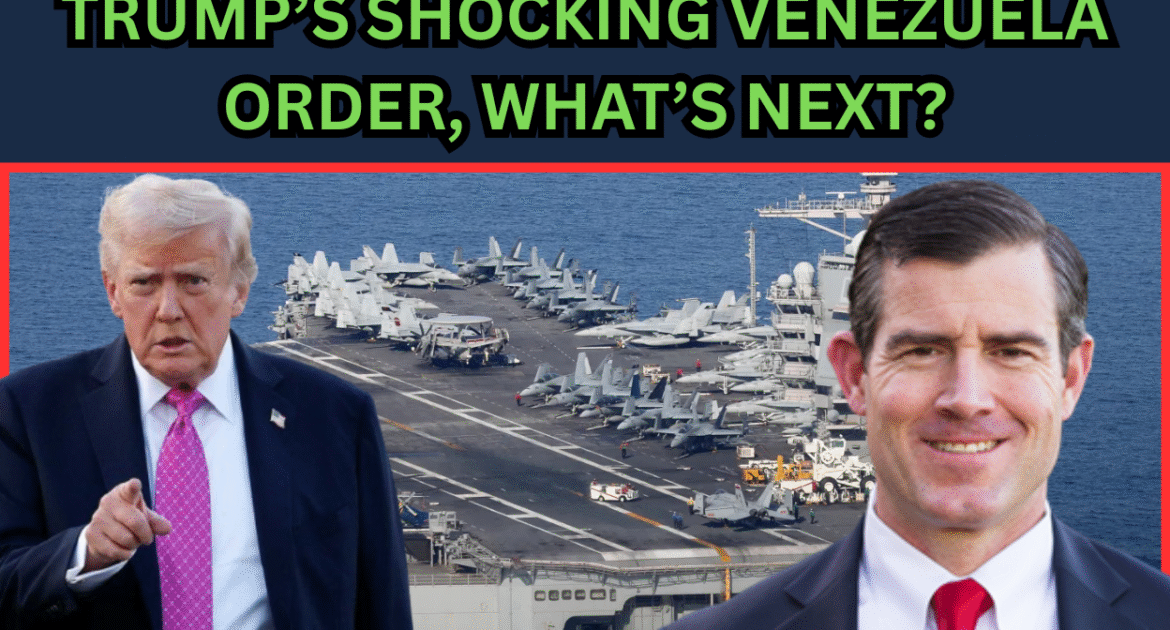
House Candidate and Former Commander Reveals Shocking Venezuela Intel (VIDEO)


WATCH: House Candidate & Former Commander Reveals Shocking Venezuela Intel
This week’s episode of The Patriot Perspective, hosted by The Gateway Pundit’s Gregory Lyakhov and Ofer Adar, dug into the fast-moving Venezuela crisis with a guest who has spent nearly three decades inside America’s wars.
Jay Furman, a retired Navy officer, Blackhawk pilot on the Texas border, former foreign area officer, and current Republican candidate for Texas’s 35th Congressional District, warned that Nicolás Maduro’s regime is no longer just a failed state.
In his view, Venezuela has become an active launchpad for a hybrid war against the United States.
Furman began by explaining why President Donald Trump’s emergency air-closure over Venezuela and the visible U.S. naval presence in the Caribbean matter.
He described the near-empty Venezuelan airspace as a classic step in “conditioning the battlefield”: clearing civilian traffic before any potential military action so that U.S. forces can target narco-trafficking hubs, terror-linked facilities, and regime assets without risking passenger aircraft.
The no-fly order, he argued, functions as “a shot across the bow and a cocking of the hammer,” designed to show Maduro, Tehran, and their partners that Washington finally treats Venezuela as a real threat, not a distant humanitarian story.
According to Furman, Venezuela has transformed from a thriving democracy into a cartel narco-state disguised as a government.
He described Maduro as an “illegitimate” head of state who relies on a Praetorian Guard and rigged elections to stay in power.
Massive oil reserves and drug profits, he argued, fund a multi-pronged campaign pointed directly at the United States.
Fentanyl and similar drugs, moved by sea, air, and across the southern border, amount in his view to “chemical-biological warfare” against American communities.
Furman tied that threat to a broader pattern of hybrid warfare: weaponized mass migration, narcotics, and election interference.
He argued that systems pioneered under Hugo Chávez allowed Venezuelan-linked actors to refine the art of “election engineering” abroad and then use those tools inside the United States.
Undermining confidence in elections, he warned, is as dangerous to the Republic as fentanyl is to individual Americans, because once faith in the ballot disappears, the entire Bill of Rights becomes meaningless in practice.
He went even further, describing Venezuela as “the Hezbollah of the South.”
In his assessment, the country has become a host for the Iranian terror network—Hezbollah, the Houthis, Hamas, and other proxies—who exploit ungoverned or cartel-governed spaces to stage operations in the Western Hemisphere.
That network, he said, works hand-in-hand with Venezuela’s Cartel de los Soles to move drugs, launder money, and position sleeper cells that can exploit the porous border.
On the strategic picture, Furman noted reports that Russia is evacuating its citizens from Venezuela as a sign that adversaries take Trump’s threats seriously.
He argued that the same firm posture that brought Iran “to heel” after the strike on Qassem Soleimani is now forcing Caracas, Moscow, and Tehran to reassess their risk.
Energy policy is another piece of the puzzle.
Furman criticized the Biden administration for squandering the petrodollar framework with Gulf allies and contrasted that with Trump’s pressure approach.
Rogue producers like Venezuela, he argued, destabilize markets by using their reserves and offshore fields, often developed with Russian help, as leverage against the West.
Neutralizing the Maduro regime and breaking its partnership with Moscow and Tehran, he said, would ultimately stabilize global oil markets and undercut revenue for hostile regimes.
Looking ahead, Furman said Congress must be ready to authorize robust action if necessary—from covert operations inside Venezuela to expanded strikes on narco and terror infrastructure.
However, he emphasized that any serious campaign must include a real post-Maduro plan so that Venezuela does not remain a permanent failed state on America’s doorstep.
Furman framed the stakes in simple terms: Venezuela is now an existential security problem in America’s own hemisphere.
In his view, President Trump’s combination of “peace through strength,” clear red lines, and willingness to act gives the United States its best chance to break the narco-terror nexus in Caracas, secure the southern border, and restore stability for both Venezuelans and Americans.
The post House Candidate and Former Commander Reveals Shocking Venezuela Intel (VIDEO) appeared first on The Gateway Pundit.