
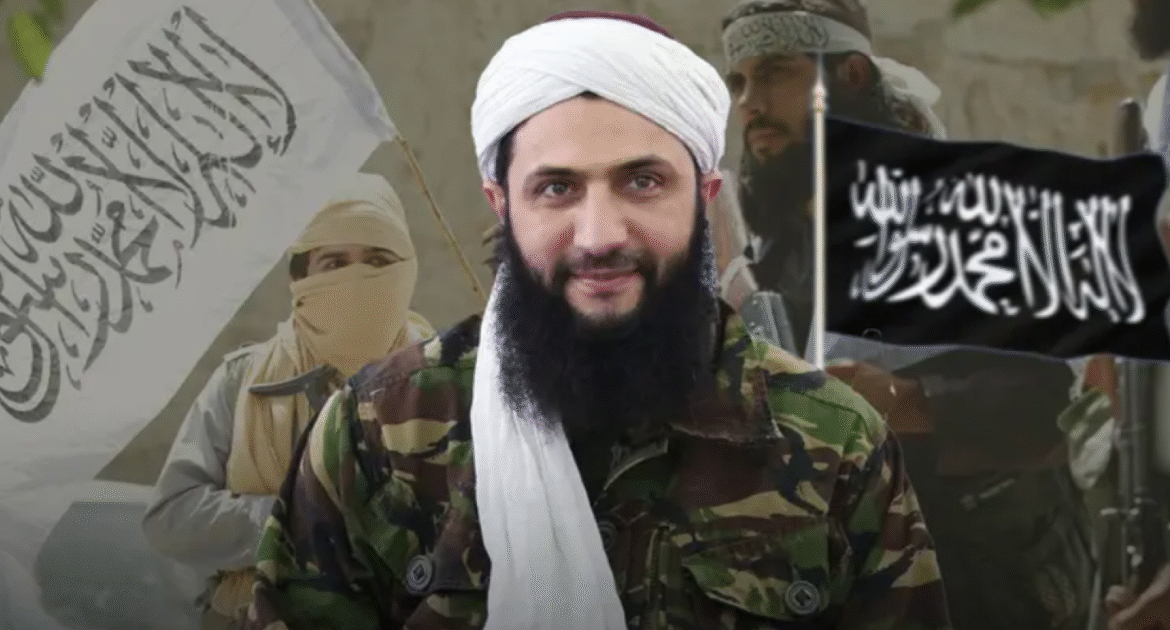
Syria Security Situation Has Deteriorated Under Former al-Qaeda Member Al-Jolani


The most dramatic change in Syria under the new government is the security environment. Minorities, Christians, Kurds, and Alawites, all make the same point: for all its faults, the Assad regime was secular. A secular strongman is repressive, but not in the same way as a religious-extremist dictatorship. Opposition to a secular ruler is political; opposition to a religious regime can be branded as opposition to the faith. That allows authorities and their supporters to label dissenters as heretics, a charge that in an extremist system can justify severe persecution.
This shift makes it far easier for groups like al-Qaeda or ISIS to mobilize followers around religious identity. Extremism then penetrates institutions, clergy, madrassas, even schools, reinforcing policies that entrench the dictator. During the Alawite massacre, for example, attackers justified the killings by calling the victims heretics and framing the violence as religiously sanctioned. Such blind devotion to brutality becomes possible only when extremists claim to be defending Islam rather than serving a political regime.
The rise of extremist leadership has been the most significant shift in Syria. Abu Mohammad al-Jolani, who entered Syria in 2011 while working under the Islamic State of Iraq, broke away to form Jabhat al-Nusra and, in April 2013, pledged allegiance to al-Qaeda, cementing his role as an extremist leader.
His current organization, Hayat Tahrir al-Sham (HTS), formed in January 2017, draws its fighters largely from former al-Qaeda affiliates and other jihadist factions, with some ISIS defectors among them, giving it one of the most hard-line ideological compositions in Syria’s history.
Jolani’s former militants now control parliament, wear state uniforms, and openly make and enforce laws across most of Syria. ISIS cells still operate in the country, periodically carrying out bombings and targeted killings. Kurds, Christians, and other minorities fear Jolani’s promises to fight ISIS are hollow, because the government he leads is built from the same extremist networks that once empowered ISIS.
This raises a central question: can Jolani truly stop ISIS, and does he even want to, when factions inside HTS may be tolerating, shielding, or quietly enabling its remnants? Minorities across Syria worry that ISIS attacks will escalate and that the group could regain strength under an extremist-dominated national government.
The Turkish-backed Syrian National Army is another hard-line faction that openly targets minorities and has carried out killings, kidnappings, and other abuses. Its presence adds yet another layer of danger to a security environment most civilians now fear. Some international media tried to portray the recent massacre of Alawites as a political purge of “Assad loyalists,” but that is not how minorities themselves describe it.

What they tell me is that the issue was never loyalty to Assad; it was that Assad, for all his faults, was secular. He did not target minorities, he protected them, so naturally they did not oppose him. Now that he is gone, they are being branded as supporters of the old regime, when in reality the attacks against them are driven by an extremist desire to eliminate minorities altogether, including Alawites, Christians, and others.
So far, there has not been a large-scale massacre of Christians in Syria, but everyone on the ground expects one. Christians tell me openly that they believe it is coming. The only reason it has not happened yet is that Al-Jolani is trying to rebrand himself as a statesman rather than an extremist, seeking legitimacy from the international community.
He knows that a mass killing of Christians would draw global outrage. When he targets other minorities, most of the world either does not understand the sectarian dynamics or simply does not care.
Historically, ISIS, al-Qaeda, and similar groups have killed far more Muslims than Christians; only a small share of their victims are non-Muslim. The massacres of Alawites in March 2025 and Druze in April 2025, however, were deliberate sectarian killings, driven by the extremists’ belief that both groups are heretics, even though the Alawites are themselves Muslim.
There have already been isolated attacks, including assaults on churches, and many expect such incidents to increase. While there has not yet been a full-scale slaughter, they consider it inevitable. Outside Kurdish-led Rojava, the situation for Christians is extremely precarious. Beyond the rising threat of violence, they also face tightening legal and social restrictions on worship and steadily diminishing freedoms.
Inside Rojava, Christians and other minorities are comparatively safe for two reasons. First, the Kurds accept them and actively provide protection. Second, minorities have full representation in both the Rojava administration and its military structures. By law, all government documents must be printed in Arabic, Kurdish, and Assyrian, formally recognizing the Christian community’s identity and equal standing.
Christian militias are integrated into the Syrian Democratic Forces, the Kurdish-led army defending the region. Dedicated Christian security units guard churches, and armed personnel stand outside every service. For foreigners, this may look intimidating, but their presence is essential: they prevent extremists from entering and bombing worshippers. Christians in Rojava are also allowed to own weapons, and many do, giving their communities another layer of security.
All of this makes Rojava far safer than Damascus-controlled Syria, where Christians are at the mercy of a government now dominated by extremist elements.
Economically, the country is in deep trouble: high unemployment, high inflation, and extremely low incomes. President Trump has already lifted some sanctions on Syria and will likely remove more. He is pushing for foreign investment and trade, a policy that grants legitimacy to the new Damascus government but appears to be a calculated move. The idea is that better economic conditions and a greater foreign presence could make large-scale human rights abuses harder to carry out and increase pressure for stability.
A similar pattern exists in Rojava and Iraqi Kurdistan. Foreign workers, executives, investors, and employees of oil and infrastructure companies, often live in Christian neighborhoods. Those areas receive heightened protection because authorities do not want investors harmed or scared away. This protection naturally extends to local Christians.
Trump seems to believe that expanding foreign investment across Damascus-controlled Syria will have the same effect. If foreign personnel require protection, the surrounding neighborhoods will also become safer. In theory, this could suppress violence and create pockets of relative stability in an otherwise dangerous environment.
The Alawite communities are deeply concerned about their future. They maintain a lobby in Washington, D.C., led by Dr. Morhaf Ibrahim, president of the Alawite Association of the United States. I have been in contact with Dr. Ibrahim, who is urging the United States to take concrete steps to protect Alawites.
Possible options include securing some form of autonomy for Alawites in their traditional areas, similar to Rojava, or facilitating relocation for those who wish to move into Kurdish-controlled territory, where they could be protected by the Kurds and potentially join the SDF.
Christian soldiers in Rojava shared similar fears with me. Speaking about the Alawite massacre, they said many of the victims were military veterans who might have survived had they kept their weapons. Instead, they had disarmed and were defenseless when the attackers arrived. This resonates with Christians, who once surrendered their weapons in Assad-controlled Syria but have not done so in Rojava, one of the reasons they are safer there.
The Druze, by contrast, remain armed and maintain their own militias. This explains the casualty numbers: more than 1,000 Alawites were killed in the massacre, while Druze deaths were in the hundreds. Their ability to defend themselves prevented far greater losses.
The Kurds, along with other Syrian minorities such as Christians, feel a sense of betrayal after President Trump met with Al-Shara at the White House. To them, the meeting appeared to legitimize an extremist government that still wants to kill them, has not changed its ideology, and continues allowing militants to operate and attack minorities.
Their concern is rooted not only in current events but also in what they describe as the “2019 betrayal,” when the United States pulled troops back from parts of Kurdish-held Syria, enabling Turkey to bomb Kurdish areas.
While traveling in Rojava with a Kurdish team leader, she pointed to an American military truck and told me, “Every time we see the Americans, we feel safe, because if the Americans are here, Turkey can’t bomb us.”
That sense of protection is why Kurds fear another abrupt U.S. withdrawal from Rojava or Iraqi Kurdistan. They still love America, but 2019 left them uneasy, and seeing Al-Shara welcomed at the White House has revived those anxieties. To them, it feels like a continuation of the same pattern of abandonment.

The post Syria Security Situation Has Deteriorated Under Former al-Qaeda Member Al-Jolani appeared first on The Gateway Pundit.