
Disqualification Scandal Grows! — Eric Swalwell Caught Using Attorney’s Address on Personal Disclosure Form


Congressman Eric Swalwell continues struggling to conceal the fact that he has not maintained a California home for the past five years, a constitutional requirement to run for Governor of California.
The controversy intensified last month following my revelations that Swalwell listed his Washington, D.C. house as his “principal residence” on legally binding mortgage documents, directly contradicting the residency qualifications under California law.
As I reported in The Gateway Pundit (‘DISQUALIFIED! – Congressman Eric Swalwell Names Washington DC Home as ‘Principal Residence’), Swalwell’s own mortgage filings designate his D.C. home as his true residence. Under both the California Constitution (Article V, Section 2) and Elections Code §349, this admission alone renders him ineligible for the office.
California Form 501: The Home Address Requirement
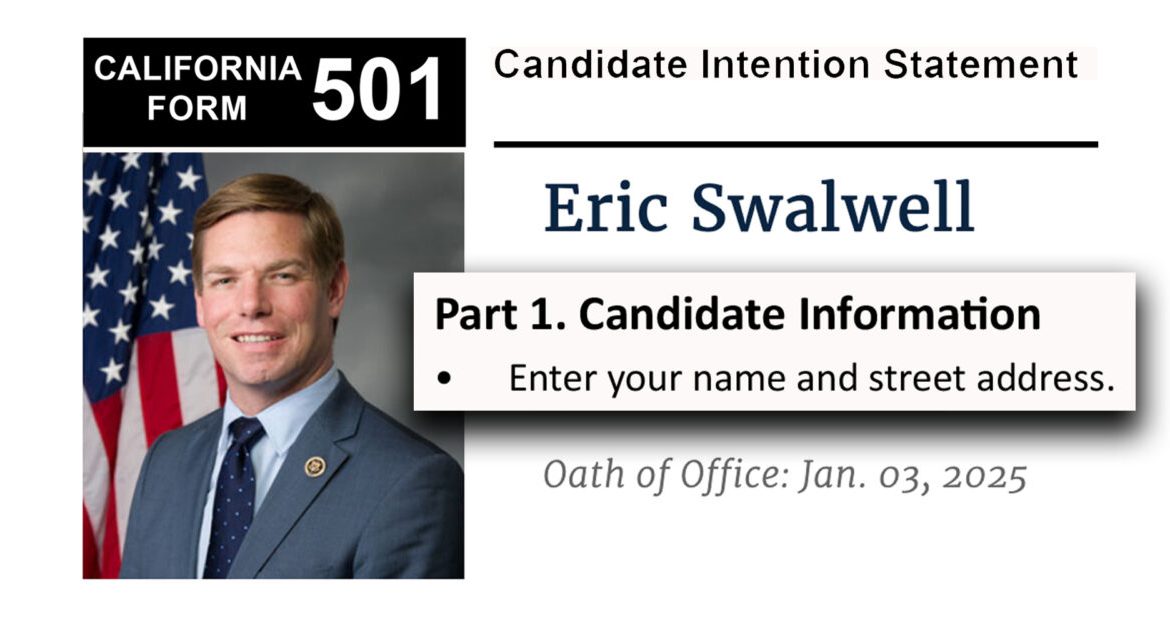
To run for governor, candidates must file California Form 501, the Candidate Intention Statement, with the Secretary of State.

The very first section, “Candidate Information,” requires a real, verifiable home street address. This mandate exists to confirm identity, establish legal residency, and prevent fraud in the candidate qualification process.
Yet on his Form 501, signed under penalty of perjury on November 11, 2015, Swalwell listed his home address as “400 Capitol Mall, Suite 2400, Sacramento, CA 95814.”
This is not his home address. It is the office of his attorneys at Greenberg Traurig, LLP, the same address (properly) used for his campaign committee on Form 410 but improperly used as a personal residential address on Form 501.
The Property Search: No California Home, Ever
Swalwell represents California’s 15th District and lists Hometown: Livermore on his Congressional profile page.
Using a document retrieval service called “Bay Area File”, I requested a property search in Alameda County public records for any property currently or previously owned by Eric Swalwell.
They reported back no property records associated with this name. Nothing.
“We attempted with different possible variations of the subject. No results matched the true name or variations.”

The conclusion is unavoidable: Eric Swalwell does not now own, nor has he ever owned, a home in Alameda County, California, which includes the city of Livermore.
Swalwell’s annual Congressional financial disclosures since 2011 independently confirm this fact. They list no California real estate and no California mortgages.
Swalwell’s inability to maintain a California home may stem from personal financial mismanagement. Swalwell’s financial disclosures for 2025 reveal a bleak picture.
Despite earning $174,000 per year for 13 years in the US Congress, Swalwell has failed to pay down his student loans of $100,000, remains mired in $100,000 of credit card debt, and has even cashed out his pension.
California’s Legal Requirements for Gubernatorial Eligibility
The California Constitution requires a gubernatorial candidate to be “a citizen of the United States and a resident of this State for five years immediately preceding the Governor’s election.”
But “resident” in California law refers not merely to where a person receives mail. It means “domicile,” a legally fixed, true, and permanent home. California Elections Code §349 states:
- “A domicile is the place where a person’s habitation is fixed and where they have the intention of remaining.”
- “At a given time, a person may have only one domicile.”
Swalwell’s public online Deed of Trust for his home at 209 S Street NE in Washington, D.C., dated April 18, 2022, confirms the property is designated as his “principal residence” as a condition of the loan.
The deed includes explicit language making the borrower liable for false or misleading statements regarding occupancy.
Clause 8 of the document includes the line “Material representations include, but are not limited to, representations concerning Borrower’s occupancy of the Property as Borrower’s principal residence.”
Swalwell cannot retroactively pretend California is his domicile to run for governor. Domicile is continuous and must be supported by evidence of actual habitation for five years.
Swalwell’s sworn principal residence mortgage document for his Washington, D.C., home does the very opposite; it is conclusive evidence of his domicile in Washington, D.C, since 2022, and not the state of California.
Swalwell’s false use of his attorney’s Sacramento office as his “home address” on Form 501 appears to be his latest effort to obscure his ineligibility.
The situation escalated when Federal Housing Finance Agency Director Bill Pulte referred Swalwell to the Department of Justice for potential mortgage fraud.
Swalwell responded by desperately filing a civil lawsuit against Pulte and FHFA, claiming in the lawsuit that his mortgage listed on the public database mytax.dc.gov is private, while claiming he included an affidavit with his mortgage claiming it was only his wife’s home.
However, no such affidavit appears in the recorded Deed of Trust, and any document Swalwell may have mailed in later, hoping to qualify for California governor, would have no legal standing. Borrowers cannot rewrite a mortgage by filing a retroactive affidavit.
Eric Swalwell’s own documents have eliminated any doubt. He has not lived in California for the required five years, he does not own a California home, and he knowingly submitted a Form 501 listing a fake residential address, his attorney’s Sacramento office, to conceal that fact.
This is not a clerical oversight. It is a deliberate attempt to bypass the California Constitution and mislead state election officials. No candidate, especially a sitting member of Congress, is entitled to falsify residency records to gain access to the governor’s office. The law applies to him just as it applies to every Californian.
California voters deserve integrity, not a candidate who treats legal filings as obstacles to be gamed.
Swalwell should withdraw immediately before the Secretary of State, the courts, or federal investigators do it for him.
The residency requirement is not optional. It is a constitutional safeguard meant to prevent exactly this type of deception, and Swalwell’s candidacy collapses the moment the facts are placed under honest scrutiny. I have already filed a complaint with the California Secretary of State.
Joel Gilbert is a Los Angeles-based film producer and president of Highway 61 Entertainment. He is the producer of the new film Roseanne Barr Is America. He is also the producer of: Dreams from My Real Father, The Trayvon Hoax, Trump: The Art of the Insult, and many other films on American politics and music icons. Gilbert is on Twitter: @JoelSGilbert.
The post Disqualification Scandal Grows! — Eric Swalwell Caught Using Attorney’s Address on Personal Disclosure Form appeared first on The Gateway Pundit.