
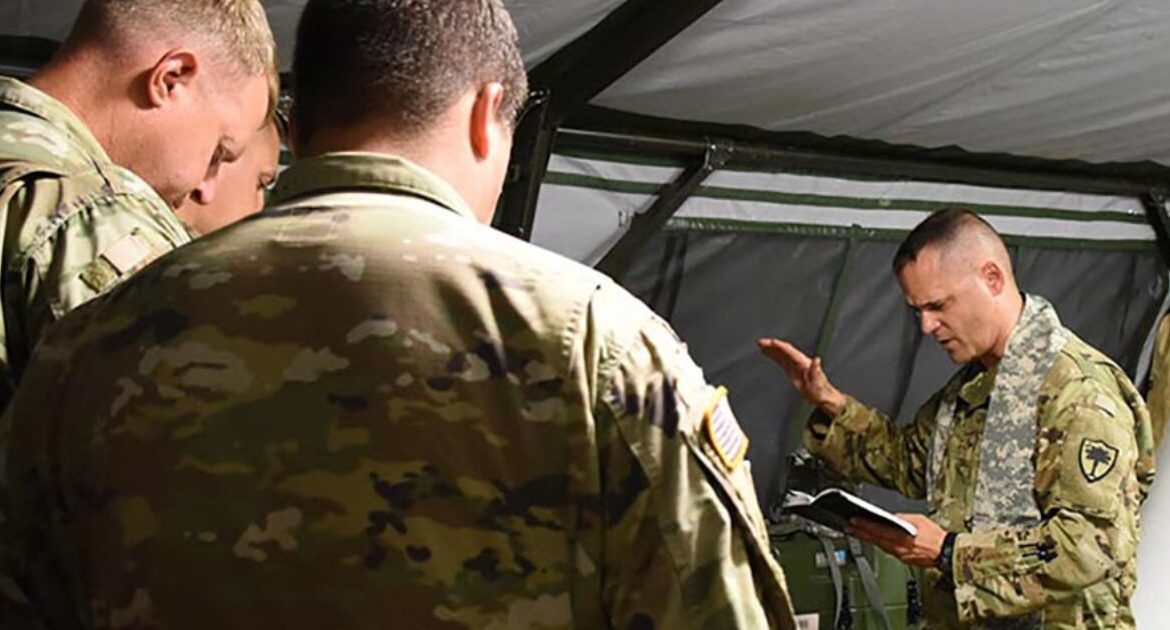
Secretary of War Hegseth Restores Faith to U.S. Military Chaplaincies, Reversing the Obama-Biden War on Religion


This week, Secretary of War Pete Hegseth addressed what he described as the dilution and destruction of the mission of U.S. military chaplains under the Obama and Biden administrations. He opened his address by warning that the U.S. military is facing a serious but largely unnoticed crisis: the steady weakening of the Army Chaplain Corps, “Serving our men and women in times of hardship and ministering to their souls.”
But sadly, as part of the ongoing war on warriors, in recent decades its role has been degraded. In an atmosphere of political correctness and secular humanism, chaplains have been minimized,” Hegseth said.
He explained that the problem has been developing for decades and has undermined an institution that was once central to the moral and spiritual life of the armed forces.
The U.S. military chaplaincy was established in 1775 by General George Washington during the American Revolution. Washington recognized the need for religious leaders to serve military forces, citing the necessity of the blessing and protection of heaven, especially in times of public distress and danger. For roughly 200 years, the Chaplain Corps served as the spiritual and moral backbone of American forces, ministering to service members in times of hardship and providing pastoral care for their souls.
The chaplain’s role, as defined in the 1956 Army Chaplain’s Manual, is to serve as “the pastor and shepherd of the souls entrusted to his care.” Today, there are an estimated 3,000 to 4,000 military chaplains serving across all branches of the armed forces.
That role, however, has been degraded in recent decades as part of what Hegseth described as an ongoing war on warriors. He argued that political correctness and secular humanism have reshaped military chaplaincy, minimizing faith and recasting chaplains as quasi-therapists rather than ministers. Virtue and moral formation, he said, have been displaced by self-help language and emotional management.
According to testimony presented at the December 10 hearing of the Presidential Commission on Religious Liberty, commissioners including Rev. Franklin Graham, Bishop Robert Barron, and policy experts heard from former military chaplains, historians, and legal advocates, with findings to be presented to President Donald Trump. Witnesses testified that hostility toward religious freedom in the U.S. military began in earnest in 2009 under the Obama administration and continued under the Biden administration.
Witnesses cited multiple policy shifts that weakened the role of faith in military life, including efforts by both Democratic administrations to outsource chaplains so they would no longer be embedded with service members. Such a move would have fundamentally altered the chaplain’s role from integrated spiritual support to contracted services detached from daily military life.
Additional concerns were raised over the Department of Defense’s April 2023 decision to end its longstanding relationship with the Holy Name College Friary and order Catholic chaplains to cease performing pastoral duties at Walter Reed National Military Medical Center, a move critics described as emblematic of the broader marginalization of faith in the military.
Further testimony described how chaplains were pushed out of teaching roles as troops were increasingly educated in an ardently secular environment with little tolerance for religious expression. Historically, military chaplains played a central role in teaching Just War theory, a doctrine of military ethics developed by Christian theologians such as St. Augustine of Hippo and later refined by St. Thomas Aquinas, which established moral criteria for the use of force and guided ethical decision-making in combat.
These principles were taught through character-guidance classes addressing military ethics, moral responsibility, and the spiritual consequences of war, and they shaped pastoral practices that emphasized confession and reconciliation before battle. When former Army Chief of Chaplains Maj. Gen. Doug Carver entered the Army in 1973, chaplains regularly taught these courses.
Christian denominations actively supported this role. The Archdiocese for the Military Services has published teaching on peace and Catholic Just War theory, explaining that for centuries the Church’s approach to war and peace has been shaped by principles developed by St. Augustine and St. Thomas Aquinas. As the sole endorsing agent for Catholic military chaplains, the Archdiocese oversees their formation and pastoral mission.
The Episcopal Church likewise developed educational resources for chaplains and, in 2003, formally urged the application of Just War principles, particularly for those ministering to service members confronting moral injury. According to testimony, however, beginning in 2009 chaplains were increasingly removed from these teaching roles, marking a decisive shift away from religiously grounded moral instruction within the military.
Carver told the commission that chaplains are now often referred to as “spiritual readiness coaches,” values facilitators, or morale officers rather than religious leaders. He recalled that when he entered the Army in 1973, chaplains taught character-guidance classes and soldiers were given a monthly day for spiritual reflection, practices that have since disappeared.
Barton cited multiple examples of hostility toward religious expression in the military, including the removal of Bible verses from equipment. He pointed to the January 2010 Trijicon rifle-scope controversy, when the Department of Defense ordered the removal of coded biblical references, such as “JN8:12” for John 8:12, that had been stamped on more than 300,000 combat optical sights for nearly three decades.
Then-Gen. David Petraeus called the inscriptions “disturbing,” and Pentagon officials said it was not Defense Department policy to place religious references on military equipment. Trijicon subsequently provided modification kits so troops could scratch off or paint over the verses, a move many military Christians viewed as an early step in systematically removing religious expression from military life.

Barton also cited orders to remove references to God from military insignia, including the 2012 Air Force Rapid Capabilities Office patch controversy. The patch originally bore the Latin motto “Opus Dei Cum Pecunia Alienum Efficemus,” meaning “Doing God’s Work with Other People’s Money.” After protests from the Military Association of Atheists and Freethinkers, the Air Force changed the motto to “Miraculi Cum Pecunia Alienum Efficemus,” removing the word “Dei” from the insignia.
Overall, Barton said chaplains were increasingly sidelined, creating a culture of fear and timidity that discouraged religious expression. Carver echoed that assessment, saying the chaplain’s role has been steadily diminished as practices such as character-guidance instruction and designated days for spiritual reflection were eliminated. He criticized the rebranding of chaplains as secular spiritual coaches, arguing that their primary role must remain religious leadership.
As further evidence of the systematic removal of faith from chaplaincy, Hegseth pointed to the Army Spiritual Fitness Guide. He said the guide spans more than 100 pages yet mentions God only once, refers to “feelings” eleven times and “playfulness” nine times, and contains no discussion of virtue. Instead, it relies on what he described as New Age concepts, defining a soldier’s spirit as “consciousness, creativity, and connection.” Although the guide acknowledges that roughly 82 percent of service members are religious, Hegseth said it alienates warfighters of faith by promoting secular humanism.
“In short, it’s unacceptable and unserious,” Hegseth said, announcing that he would sign a directive eliminating the guide effective immediately. “These types of training materials have no place in the War Department. Our chaplains are chaplains, not emotional support officers, and we’re going to treat them as such.”
Hegseth said additional reforms planned for the coming weeks are intended to restore chaplains to their historic role as moral anchors within the fighting force, including a top-down cultural shift that places spiritual well-being on equal footing with mental and physical health. The goal, he explained, is to support not only the bodies and minds of service members, but their souls.
He cited the 1956 Army Chaplain’s Manual, which states that “the chaplain is the pastor and shepherd of the souls entrusted to his care” and describes the role as “a high and sacred calling.” That mission, Hegseth emphasized, can succeed only if chaplains are given the freedom to boldly guide and care for their flocks without institutional restraint.
The post Secretary of War Hegseth Restores Faith to U.S. Military Chaplaincies, Reversing the Obama-Biden War on Religion appeared first on The Gateway Pundit.