
The Real Story of Eric Swalwell and Fang Fang, His Chinese ‘Honey Trap’ Spy

Chinese national Fang Fang, who adopted the Americanized first name “Christine”, was a suspected Chinese intelligence operative who embedded herself in U.S. political circles between 2011 and 2015.
One of the politicians she cultivated was California Congressman Eric Swalwell, now a candidate for governor of California.
Fang arrived in the United States in 2011, enrolling at California State University, East Bay.
Despite appearing around 10 years older than most students, she quickly rose to prominence, becoming president of both the Chinese Student Association and the campus chapter of Asian Pacific Islander American Public Affairs.
Fang’s activities extended well beyond campus. She spent substantial time attending Democratic Party networking events throughout the Bay Area and elsewhere, placing herself in close proximity to rising political figures.
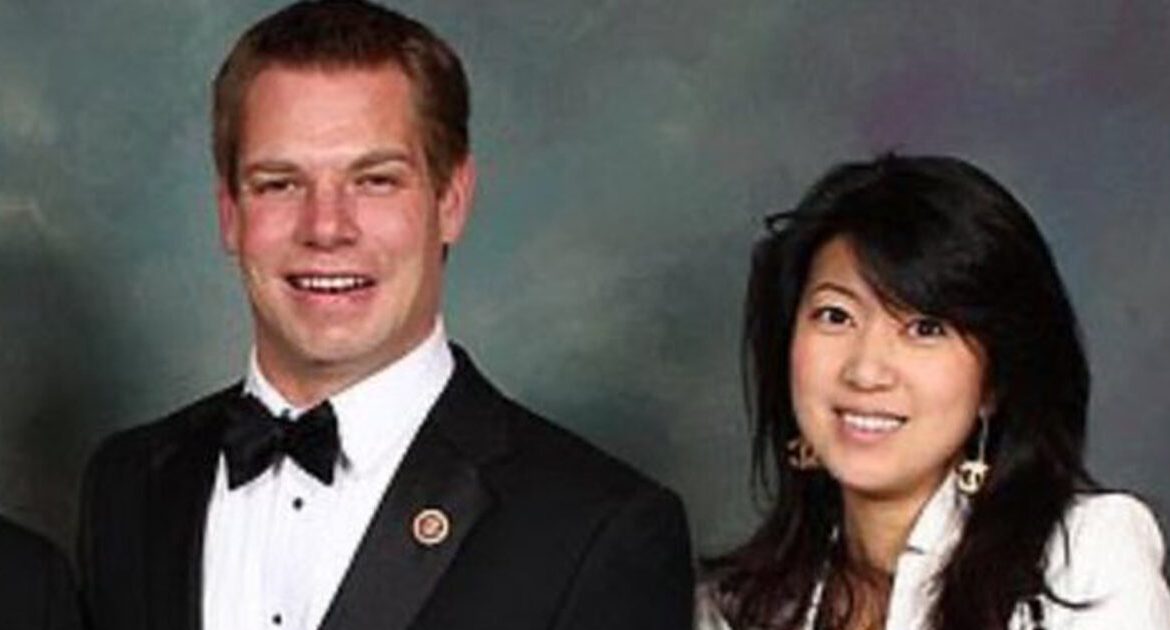
In October 2012, she was photographed at a political event alongside Eric Swalwell, who at the time was a Dublin City Council member campaigning for Congress.
During that campaign, Fang reportedly brought Swalwell donors, helped raise funds, and recommended at least one intern who ultimately worked in Swalwell’s congressional office.
After his election, Swalwell was appointed to the House Permanent Select Committee on Intelligence in January 2015, later serving as the lead Democrat on the CIA oversight subcommittee.
Fang’s political reach was not limited to Swalwell. She was photographed with a Chinese consular official and Russell Lowe, the longtime office director for Senator Dianne Feinstein, who was later revealed to have been a Chinese intelligence agent himself.

Fang also appeared alongside multiple elected officials, including Fremont Mayor Bill Harrison, Representatives Judy Chu and Mike Honda, and San Jose City Councilmember Ash Kalra.
According to reporting by Zach Dorfman for Axios, Fang also cultivated romantic or sexual relationships with at least two Midwestern mayors, indicating a broader national strategy rather than an isolated local effort.
Swalwell’s FBI Briefing
In 2015, the FBI delivered a defensive counterintelligence briefing to Congressman Swalwell regarding Fang. Swalwell has stated he was “shocked” and immediately cut off contact.
That may be true, but the very fact that the FBI deemed a defensive briefing as necessary places the Swalwell-Fang relationship squarely in the category of a security concern.
Counterintelligence logic raises an obvious question. If Swalwell had been uncooperative, guarded, or of little use to Fang, why did she remain in his orbit for years, and long enough for the FBI to deem the relationship a risk?
Foreign intelligence operatives do not linger out of sentimentality. They invest where they see potential value.
“Honey Trap” Operations and the Intelligence Committee
Counterintelligence professionals have long warned that foreign services, particularly China’s, use “honey trap” operations to compromise or influence targets.
These operations rarely involve immediate demands for classified information. Instead, they focus on ego reinforcement and long-term relationship building.
The goal is leverage over time. Spies want to identify vulnerabilities and position other assets close to future decision-makers. Fang’s focus on a young, ambitious politician like Eric Swalwell early in his career fits this model precisely.
Following the public exposure of the Fang matter, Senator Rick Scott stated that Swalwell “has no place” on the House Intelligence Committee in light of the revelations.
Swalwell was subsequently removed from the Committee because his association with Fang alone posed unacceptable risk.
Financial Vulnerability Concerns
Beyond the counterintelligence issues, Swalwell’s personal finances raise additional red flags. As I highlighted in The Gateway Pundit, his 2025 financial disclosure presents a troubling picture.
Despite earning approximately $174,000 annually for 13 years in Congress, Swalwell’s debts have remained largely unchanged since his first campaign in 2011.
Swalwell failed to reduce his student loan debt, which remains at around $100,000. He also carries credit-card balances around $50,000 each with both American Express and Chase, and has reportedly cashed out his pension (a serious red flag).
Persistent financial instability at that income level raises serious questions about judgment and responsibility. In national-security contexts, debt is not just a personal issue, it is a security risk.
National security is not about whether wrongdoing can be proven beyond a reasonable doubt. It is about whether someone can be trusted given their vulnerabilities.
Eric Swalwell managed to check every box intelligence professionals warn against: a single man with years of close proximity to a suspected female foreign operative, access to classified oversight, questionable judgment, and ongoing personal financial vulnerabilities. The pattern alone is disqualifying.
And here’s the uncomfortable punchline. Even if Swalwell was not compromised, if he couldn’t spot, or stop, a foreign influence operation happening in his own campaign and Congressional office, why should anyone trust him to run a state the size of California?
Joel Gilbert is a Los Angeles-based film producer and president of Highway 61 Entertainment. He is the producer of the new film Roseanne Barr Is America. He is also the producer of: Dreams from My Real Father, The Trayvon Hoax, Trump: The Art of the Insult, and many other films on American politics and music icons. Gilbert is on Twitter: @JoelSGilbert.
The post The Real Story of Eric Swalwell and Fang Fang, His Chinese ‘Honey Trap’ Spy appeared first on The Gateway Pundit.