
AbleChild: Why Did a TMS Tech Walk into Charlie Kirk’s Assassination Crime Scene?


Photo & Artist Credits: Dan Fleuette & Sean Danconia
News Story Photo Credit: New York Post
Why Did a TMS Tech Walk into Charlie Kirk’s Assassination Crime Scene?
Russell Kim Kennington’s presence inside the crime scene where Charlie Kirk was assassinated is not just a side detail; Kennington’s background deepens the public’s right to demand answers about what occurred at the Utah Valley University (UVU).
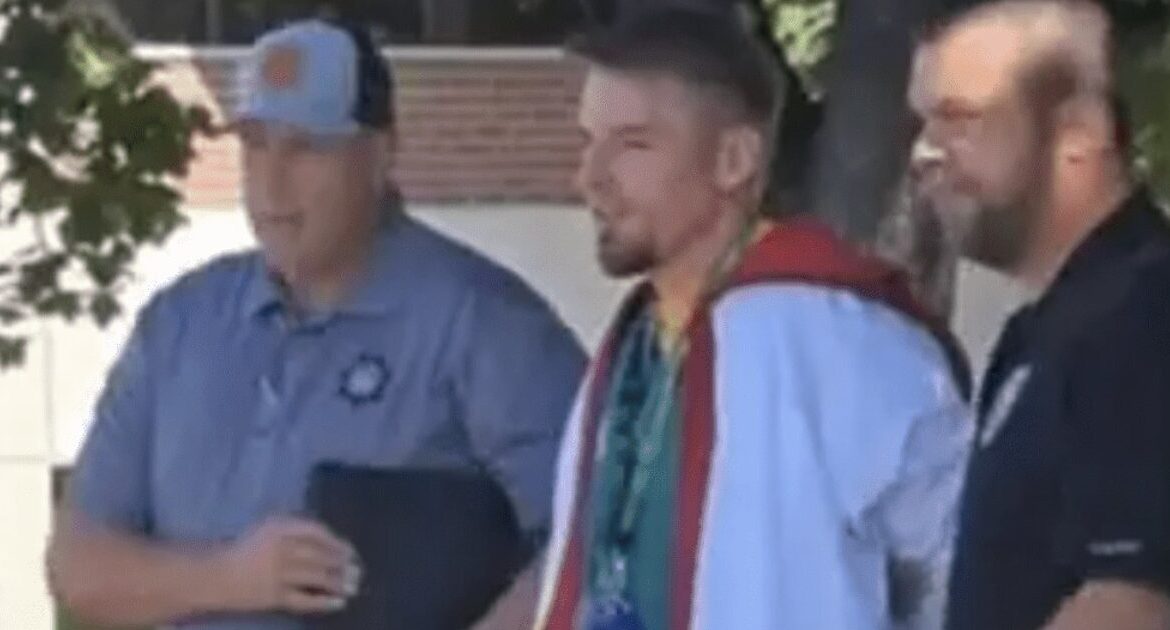
Thirty-eight year old Kennington of Pleasant Grove Utah sauntered into the taped-off crime scene at UVU crossing multiple layers of police tape, wearing a white lab coat, took random photographs and video of critical evidence, and ultimately was arrested on suspicion of obstruction of justice and criminal trespass. After a brief search, it appears that Kennington is not some random onlooker with a cell phone as his work and history sit squarely inside the psychiatric and mental reprogramming industry that already hovers over Utah’s behavioral-health landscape.
Public profiles show that Kennington works as a Transcranial Magnetic Stimulation (TMS) technician at TMS Solutions, a company delivering brain-stimulation treatments often marketed as relief from depression and related conditions. Before that, Kennington is listed as having worked for years as an imaging clerk at Intermountain Healthcare and also as a U.S. Army combat medic, giving him a mix of medical, mental-health-adjacent, and technical experience that makes Kennington’s decision to enter an active homicide crime scene even more troubling.
While there is no public record that Kennington worked specifically in an Intermountain transgender-care psychiatric unit, his prior Intermountain employment means yet another figure with ties to Utah’s mental health system that also happens to be at the center of the Kirk death crime scene.
Transcranial magnetic stimulation clamps a powerful electromagnet against a person’s skull and fires rapid pulses into the brain that are strong enough to force tiny electrical currents into targeted mood and behavior circuits. TMS is a medically authorized, heavily marketed psychiatric intervention with limited, questionable evidence of success but does have real risks. TMS is not a proven, reliable cure, and still under active scientific debate.
What makes Kennington’s story even more concerning is how neatly it fits into a larger pattern where the psychiatric industry continually appears at the margins of death investigations, while simultaneously fighting efforts to fully test and disclose psychiatric-drug involvement.
In Wyoming, during testimony on a Toxicology and Autopsy Transparency Act, a psychiatrist who actively promotes TMS treatment testified against requiring full blood testing for psychiatric drugs in suspicious deaths, opposing broader toxicology transparency when families and lawmakers were seeking stronger access to medication data. The message from that testimony was clear: keep certain drug information more difficult to obtain, even when the public is asking for full visibility into what is in a person’s system at the time of death to protect public safety.
Repeatedly, the record shows of mass shootings, assassinations, and attempted assassinations, the lives of accused perpetrators are saturated with behavioral-health professionals and systems—from therapists and psychiatrists to care coordinators and program vendors—raising legitimate questions about how these same institutions shape treatment decisions before a tragedy and control information after it.
A TMS technician with prior Intermountain employment slips into the heart of a political assassination crime scene, crossing police lines while Governor Cox and Sheriff Mike Smith make no mention, hold no news updates on the breach of security that occurred calling into question their role in this political assassination.
Case after case, the people orbiting the accused are not just ordinary parents or neighbors; they are often behavioral-health “experts,” coordinators, or industry insiders who live and work inside the very systems that decide what treatment is provided, what information gets documented, and what information is later hidden behind privacy laws.
The pattern is not subtle. When people die—whether in a political assassination, a school/church shooting, or a contested in-custody death—the psychiatric industry keeps turning up at the crime scene, in the medical records, in the legislative chambers where laws are written about what can and cannot be tested or disclosed, and sometimes even in the family roles of the accused themselves. Yet at every step, the public has to fight for basic facts: who crossed the tape, what was in the blood, which drugs or treatments were in play, and who inside the behavioral-health system had both knowledge and responsibility.
Psychiatry and its satellite industries are not neutral bystanders; it is woven into the systems that shape how deaths are investigated, what is tested, and what the public is allowed to know—and when a TMS technician with prior Intermountain ties walks into the Kirk crime scene in a lab coat, it becomes one more data point in a disturbing, repeated pattern.
Be the Voice for the Voiceless
AbleChild is a 501(3) C nonprofit organization that has recently co-written landmark legislation in Tennessee, setting a national precedent for transparency and accountability in the intersection of mental health, pharmaceutical practices, and public safety.
What you can do. Sign the Petition calling for federal hearings!
Donate! Every dollar you give is a powerful statement, a resounding declaration that the struggles of these families will no longer be ignored. Your generosity today will echo through generations, ensuring that the rights and well-being of children are fiercely guarded. Don’t let another family navigate this journey alone. Donate now and join us in creating a world where every child’s mind is nurtured, respected, and given the opportunity to thrive. As a 501(c)3 organization, your donation to AbleChild is not only an investment in the well-being of vulnerable children but also a tax-deductible contribution to a cause that transcends individual lives.
The post AbleChild: Why Did a TMS Tech Walk into Charlie Kirk’s Assassination Crime Scene? appeared first on The Gateway Pundit.