
Burma’s Conscription Law: Destroying Education and Accelerating Brain Drain


The Burma (Myanmar) military junta activated its conscription law on February 10, 2024, requiring men aged 18 to 35 and women aged 18 to 27 to serve in the military. Professionals, including doctors, engineers, and technical specialists, can be conscripted up to age 45 for men and 35 for women.
Those conscripted are required to serve a minimum of three years. This includes educated adults with engineering, medical, and technical skills, further draining Burma’s already collapsing education and professional sectors.
Conscription means serving a junta that seized power in 2021 by overthrowing the elected government and arresting pro-democracy leaders. It also means being forced into a civil war in which as much as 80 percent of the population opposes military rule.
For ethnic minorities, who make up roughly 40 percent of the population, conscription is especially devastating. It means being ordered to participate in widespread atrocities, including murder, rape, and the burning of villages, directed against their own families and communities.
The International Labour Organization estimates hundreds of thousands have fled Burma to escape conscription since February 2024. Fear of being drafted drove so many young men to flee to Thailand in 2024 that they set a record for the highest annual number of undocumented Burma migrants to arrive in Thailand. The International Organization for Migration estimates over 4 million Burma migrants live in Thailand, about half of whom are undocumented. In addition to the personal hardship, they face as undocumented aliens in Thailand, separated from their families, the conscription law is decimating Burma’s education system.
At the beginning of the revolution, thousands of students walked away from junta-run universities and schools as part of the civil disobedience movement. Many shifted to alternative education options, including community-run higher education institutions in ethnic minority areas and online programs. The conscription law, however, made it unsafe for them to remain in Burma while completing these programs.
As a result, the Thailand Education Fair held in April 2024 saw overwhelming attendance, and the November 2024 fair was extended to two days as attendance doubled. Students whose families can afford it, or who secure scholarships, are fleeing to study at Thai universities. As Burma’s economy collapses, however, this option has become increasingly out of reach. Annual tuition of roughly $3,000 represents about two years’ salary for Burmese families fortunate enough to still have employment.
The law has exacerbated a brain drain that was already causing young people to leave Burma, impacting education and the labor market.
The United States Agency for International Development funding freeze suspended the Development and Inclusive Scholarship Program, affecting more than 400 Burma students pursuing degrees in the Philippines, Cambodia, Indonesia, and Thailand. Inside Burma, parents are pulling children out of school and sending them to neighboring countries to look for work, driven by fear of conscription. Both inside Burma and across the region, child labor violations involving children aged 12 to 16 have increased as youth fleeing the country or joining resistance forces have created labor shortages.
The crisis extends beyond students. Teachers and professors have either fled to the jungle to join the resistance or escaped the country altogether in search of work. As a result, educated adults and former professionals now find themselves in Thailand and other countries working as day laborers alongside young people who fled before finishing university, or in many cases, even high school.

For a growing number of Burmese students whose education was interrupted, the American GED exam has become a last remaining option. Numerous small-scale programs, many of them faith-based, have emerged in Thailand, offering free preparatory courses, with some even providing meals or housing for undocumented Burmese youth. Completing the GED, however, can feel like a hollow achievement for students who cannot afford to continue on to university.
About 100,000 Burmese in Thailand qualify as official refugees and are able to live in UN-sponsored camps where they receive food, housing, and access to education. However, they have little freedom to leave the camps or to work. These camps are generally designated for specific ethnic groups, but the Shan people, one of the largest ethnic minorities from Burma, have no such UN-recognized camp.
Instead, many Shan live in an unofficial settlement known as Koung Jor Shan Refugee Camp, located along the Thai–Burma border. While official camps often house thousands or even tens of thousands of people, Koung Jor is home to only a few hundred. Residents live without UN support and under an ambiguous legal status, fearing deportation at any time. Because they lack official status, they are not authorized to work.
Though grim, the camp represents the lesser of two evils. Life there is defined by a combination of insecurity, poverty, and legal uncertainty, yet it is still preferable to remaining in Burma, where families were subjected to airstrikes and other atrocities, and teenagers were being seized by the junta’s army and forced to fight.
Inside the camp, a boarding house provides shelter for orphans and children who fled as unaccompanied minors. The facility has been operating for more than 20 years and is supported by non-governmental organizations with very limited funding. Although the Shan are the predominant group in the camp, the boarding house serves children from multiple ethnic backgrounds, including Shan, Lahu, and Lisu.
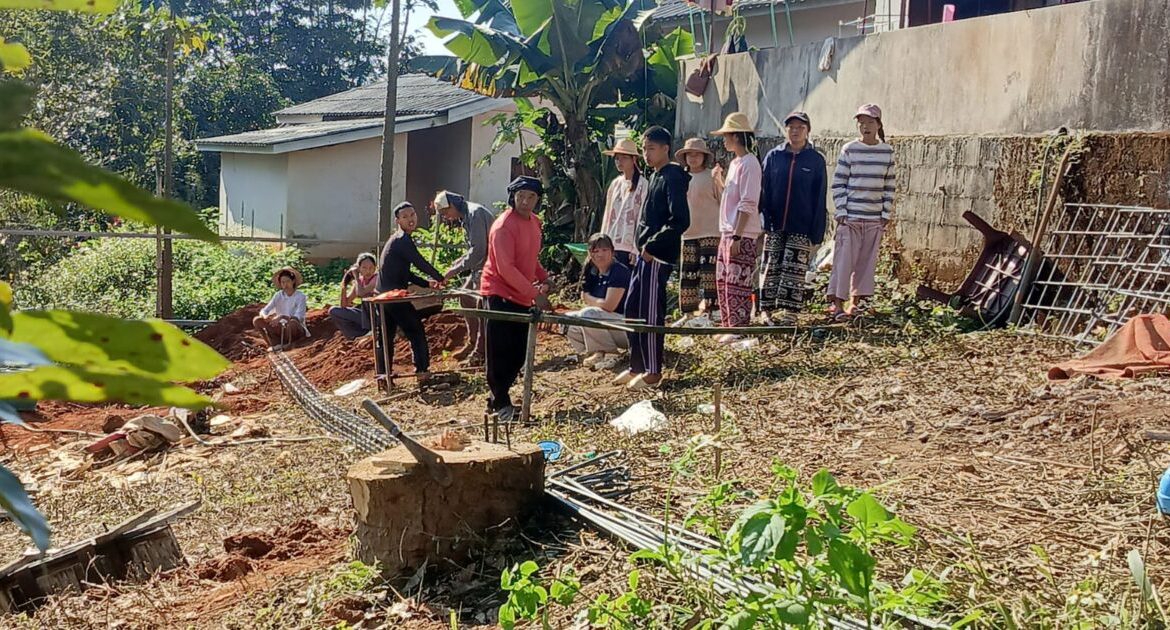
The school survives through private donations and limited NGO support and maintains a long waiting list, as desperate parents seek a safe place for their children to live and study. Sai Bee, a 40-year-old Shan man who oversees the school, said he was hopeful that after months of scrambling to secure additional donor funding and discounted construction materials, they were finally able to expand the school and its dormitories. He explained that during school holidays, the children help with the construction work, which kept construction costs down.
When asked why he continues to accept more children despite the severe limitations in shelter space and funding, Sai Bee replied, “When these children come seeking help with tears in their eyes, it is very difficult to ignore them or turn them away.”
Two of the boys helping with the construction are Sai Harn Khur, a 17-year-old Shan boy, and Sai Lao Kham, 16. Both are originally from Na Kong Moo village in Mong Ton Township, eastern Shan State, near the border with Thailand’s Chiang Mai Province. When asked why they came, both said the situation at home had become unsafe. In addition to the dangers of the war, their parents feared they would be conscripted.
Although the law sets the minimum age at 18, it is not unusual for boys as young as 14, or even younger, to disappear and never return home. Parents later learn that their sons were forcibly recruited. In many cases, agents ambush, deceive, or drug boys and then sell them to the army to collect a bounty. Desperate parents are therefore looking for any way to get their children, especially boys, out of the country.
Both boys said they were grateful for the boarding house because it allows them to live in safety while continuing their education. However, this also means they will likely be separated from their parents for years, possibly for the rest of their lives, as returning to areas controlled by the regime would be unsafe.
Because of the years of education they missed in Burma and the language barrier, newly arrived Burmese children are typically placed in much lower grades. Although Sai Harn Khur and Sai Lao Kham had completed grades 10 and 9 respectively in Burma, they were admitted into grade three, primary school, in Thailand’s education system.
Many undocumented Burmese in Thailand are effectively stateless. The only way for them to obtain a passport would be to return to Yangon, Burma’s former capital, and apply through a government office, where they would almost certainly face arrest or forced conscription. As a result, their future remains deeply uncertain.
For Sai Harn Khur and Sai Lao Kham, perseverance may allow them to complete high school. Beyond that, no clear path exists. Every displaced Burmese person carries some hope of returning home after the war, yet the conflict has continued in some form since 1948, with little indication it will end anytime soon.
Meanwhile, the best and brightest, the youngest and most capable, continue to pour across the border, draining the country of the very population needed to rebuild it.
The post Burma’s Conscription Law: Destroying Education and Accelerating Brain Drain appeared first on The Gateway Pundit.