
Exclusive Report from Burma: How Bunkers and Dispersed Classes Protect Children in a War Zone


After the 2021 coup that overturned a democratic election, Burma has been engulfed in a full-blown revolution, with the vast majority of the population fighting against the SAC, the military junta that seized control of the country. Over 125 resistance armies exist, but most are now cooperating with one another.
The shifting front lines between resistance-held territory and government-controlled areas have caused massive displacement. At least 3.6 million people are internally displaced, many living in makeshift shelters or open fields with little access to food, clean water, or health care. Rising prices driven by war inflation, combined with limited medical access, have worsened malnutrition, waterborne disease, and preventable deaths.
The ethnic states of Burma, where these battles are taking place, do not produce finished goods and can no longer import supplies from the interior of the country. As a result, nearly all products must be imported, including gasoline, which is carried by truck and on foot in small quantities across miles of jungle terrain through active war zones. By the time these goods reach the small towns and villages, prices have doubled or tripled.
Displacement has also prevented people from farming, making them more dependent on imported rice, which has become unaffordable for many, as most people have no income. As a result, more than 15 million people now face acute food insecurity.

Burma is a Buddhist-majority country; however, Karenni State, the smallest state with a population of fewer than 350,000, is the only Catholic-majority state in the country.


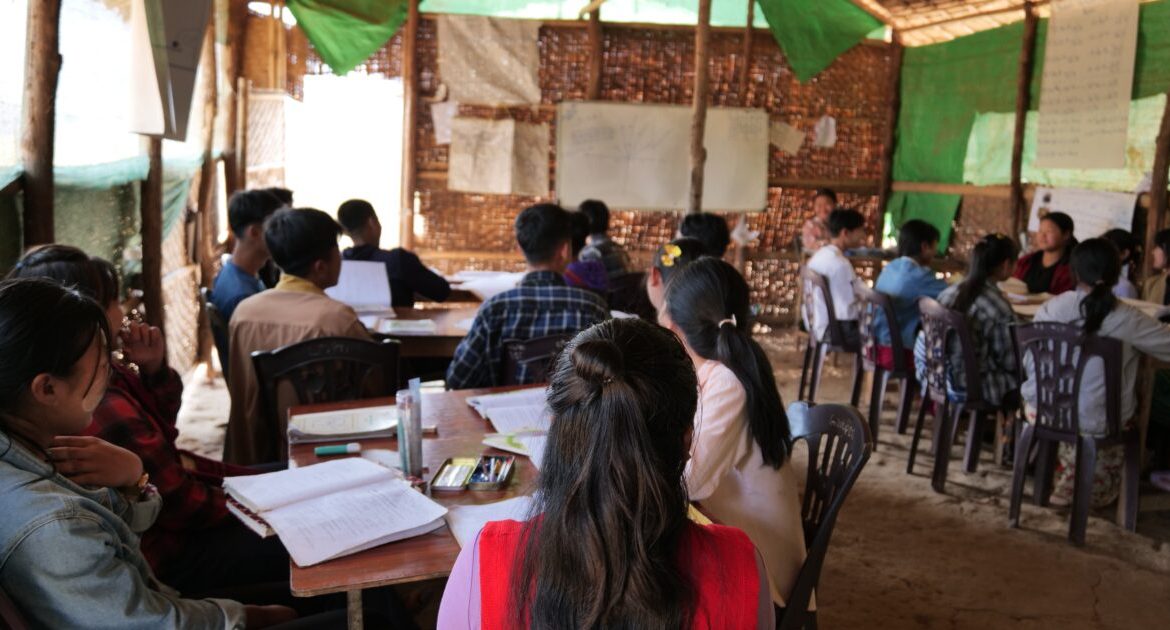
I interviewed a local priest who is helping to support a school serving 2,000 children. They and their families live in nearby displaced people’s camps that make up his flock. Although this part of Burma is Catholic majority, the camps and schools accept families and children irrespective of religion or ethnicity. The Father said “This is how we show God’s love.”
Many of these families have been forced to move three or more times since the coup, leaving them with no fields, no crops, no jobs, and no income. As a result, the school cannot charge fees and must rely entirely on donations to operate.
The school provides lunch only through grade five and operates only through grade ten. For grades eleven and twelve, students must travel to another village, but most parents do not have a vehicle or the money to send them.
One of the central problems facing internally displaced people is that they are not refugees and have no special legal status or support from the United Nations. International aid, including funding from major aid organizations and foreign governments, can only be delivered to government-controlled areas, leaving displaced communities in resistance-held territory with no protection and no support. In addition to struggling each day to find food, these families must also endure ongoing airstrikes and mortar attacks carried out by their own government.


The campus bore many sad reminders of the war. Several posters warned children how to identify landmines and unexploded ordnance and not to play with them. Outside the teacher’s office, there was an air raid alarm, a walkie-talkie that was part of a larger network of spotters. When aircraft are seen approaching, a warning is passed along. There were ditches behind the school buildings, and the children knew to jump into them if the teacher gave the signal or if they heard planes overhead.
To make the school less of a target, the middle school and high school were set about 500 meters apart, and the kindergarten was located about a kilometer away, under cover. The Burma army frequently targets schools, churches, hospitals, clinics, and temples.
Another poster warned children about airstrikes and incendiary bombs that their government periodically drops on them. The priest told me that during one airstrike, two school buildings were hit and a third bomb landed in a nearby field. Fortunately, it happened during the semester break, when the children were not there. The school has since been rebuilt, but the frontline keeps moving closer.

The post Exclusive Report from Burma: How Bunkers and Dispersed Classes Protect Children in a War Zone appeared first on The Gateway Pundit.